Table of Contents
ToggleIntroduction
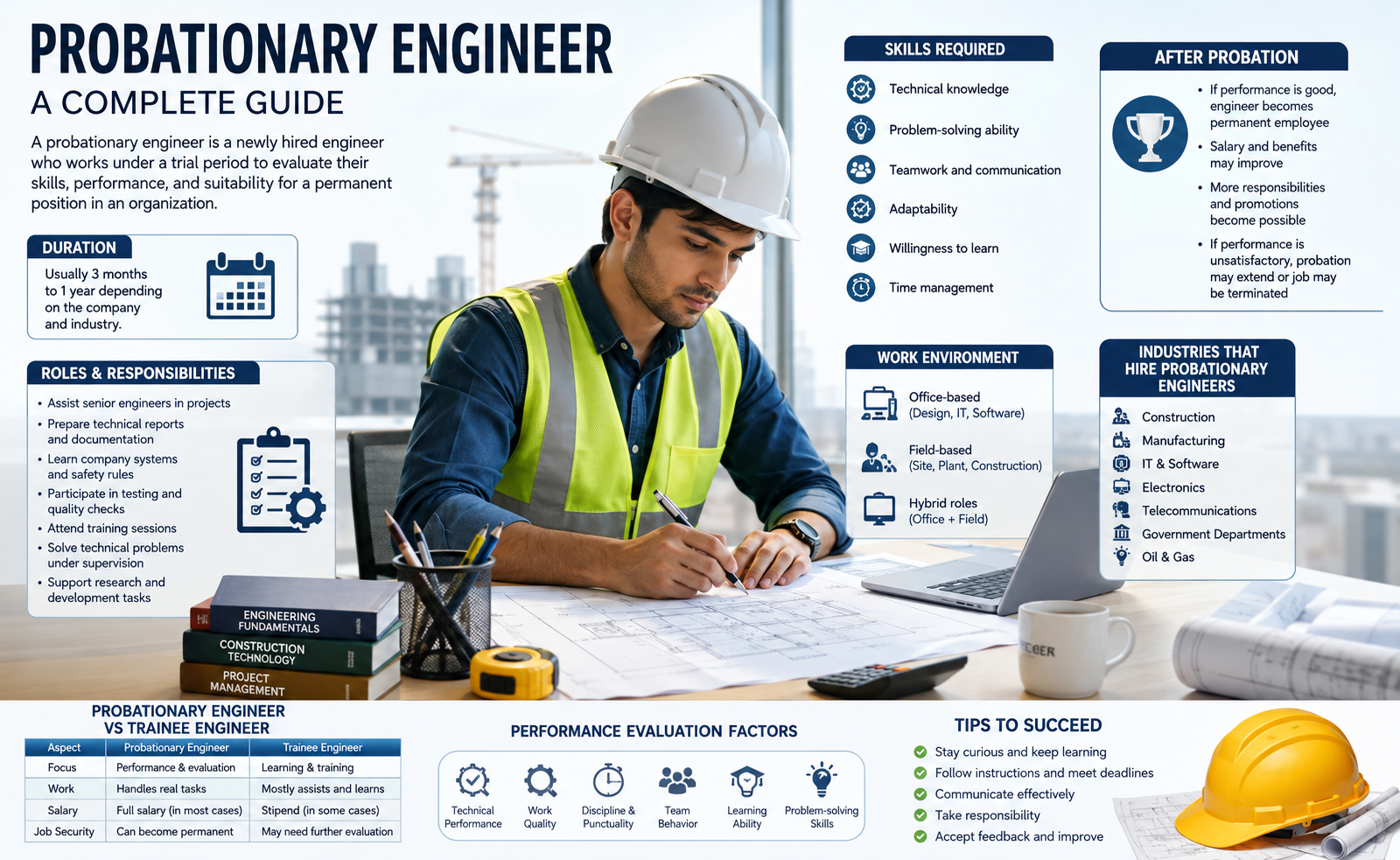
A Probationary Engineer is an entry-level professional position in engineering where a newly graduated engineer joins a company on a temporary evaluation basis. This stage is designed to assess the engineer’s technical ability, problem-solving skills, discipline, teamwork, and overall suitability for long-term employment.
In simple terms, a probationary engineer is not yet a permanent employee. Instead, they are working under a structured “trial period” during which the organization evaluates their performance in real working conditions. This role is extremely important in shaping a fresh graduate into a skilled, industry-ready professional.
Almost every engineering field—including civil, mechanical, electrical, chemical, software, and electronics—offers probationary positions in some form. It is often the first step in a professional engineering career.
Meaning of Probationary Engineer
The term “probationary” refers to a testing or trial phase. When applied to engineering jobs, it means that the engineer is under observation for a fixed period.
During this time:
- The engineer performs assigned tasks under supervision
- Senior engineers monitor their performance
- The company evaluates technical and behavioral skills
- Final confirmation depends on successful completion of probation
This phase ensures that only capable and well-adapted individuals are absorbed into permanent roles.
Duration of Probation Period
The probation period varies depending on the company, country, and industry. However, it generally lasts:
- 3 months (short probation)
- 6 months (most common duration)
- 1 year (for government or large-scale organizations)
Some organizations may extend probation if performance is average or requires improvement.
Roles and Responsibilities of a Probationary Engineer
A probationary engineer is expected to learn quickly while also contributing to real engineering work. Their responsibilities are a combination of training and practical tasks.
1. Assisting Senior Engineers
Probationary engineers work under experienced professionals and assist them in daily engineering tasks such as project planning, design, and execution.
2. Learning Technical Systems
They are trained in company-specific software, machines, tools, and engineering systems used in operations.
3. Preparing Reports and Documentation
They may be required to prepare:
- Technical reports
- Project documentation
- Work progress summaries
- Safety reports
4. Participating in Projects
They are often assigned small sections of larger projects to gain hands-on experience.
5. Quality Control and Testing
In manufacturing or construction industries, probationary engineers help in:
- Inspection
- Testing materials
- Ensuring quality standards
6. Attending Training Sessions
Companies provide structured training programs to improve technical knowledge and professional skills.
7. Following Safety Standards
Engineering fields require strict safety compliance, and probationary engineers must learn and follow all safety rules.
8. Problem-Solving Support
They assist in identifying and solving technical issues under supervision.
Skills Required for a Probationary Engineer
To succeed in a probationary engineering role, a candidate must develop both technical and soft skills.
Technical Skills
- Strong understanding of core engineering concepts
- Basic knowledge of industry tools and software
- Ability to interpret technical drawings or data
- Problem-solving and analytical thinking
Soft Skills
- Communication skills
- Teamwork and collaboration
- Time management
- Adaptability
- Willingness to learn
Professional Skills
- Discipline and punctuality
- Responsibility toward tasks
- Ability to handle pressure
- Ethical work behavior
Work Environment of a Probationary Engineer
The working environment depends on the industry:
1. Office-Based Roles
In IT or design engineering, probationary engineers work in offices using computers, software tools, and simulation systems.
2. Field-Based Roles
In civil or mechanical industries, engineers may work on construction sites, factories, or industrial plants.
3. Hybrid Roles
Some positions require both office and fieldwork, especially in large infrastructure projects.
Regardless of the environment, supervision is always present during the probation period.
Training and Learning Phase
The probation period is heavily focused on learning. Companies invest time and resources in training new engineers.
Common Training Areas:
- Company policies and procedures
- Technical systems and tools
- Safety regulations
- Project management basics
- Communication and reporting methods
This training ensures that engineers gradually become independent professionals.
Performance Evaluation During Probation
Companies evaluate probationary engineers based on multiple factors:
1. Technical Performance
Ability to understand and apply engineering concepts effectively.
2. Work Quality
Accuracy, attention to detail, and output quality.
3. Discipline
Attendance, punctuality, and professionalism.
4. Team Behavior
Cooperation with colleagues and supervisors.
5. Learning Ability
How quickly the engineer adapts to new tasks and tools.
6. Problem-Solving Skills
Ability to handle technical challenges effectively.
What Happens After the Probation Period?
At the end of the probation period, the company makes one of the following decisions:
1. Confirmation (Permanent Job)
If performance is satisfactory, the engineer is promoted to a permanent position. This includes:
- Job security
- Salary increase
- Full employee benefits
- Career growth opportunities
2. Extension of Probation
If performance is average, the company may extend the probation period for further evaluation.
3. Termination
If performance is unsatisfactory, employment may be ended.
Career Growth After Becoming Permanent
Once confirmed, a probationary engineer begins a long-term professional journey.
Career Progression Path:
- Junior Engineer
- Engineer
- Senior Engineer
- Project Manager
- Department Head
- Engineering Director
Growth depends on experience, skills, and performance.
Importance of Probationary Engineer Role
This role is important for both companies and employees.
For Companies:
- Helps identify skilled employees
- Reduces hiring risks
- Ensures workforce quality
For Employees:
- Provides real-world experience
- Builds technical confidence
- Opens career opportunities
- Helps transition from academic to professional life
Challenges Faced by Probationary Engineers
While this role is valuable, it also comes with challenges:
1. High Learning Pressure
New engineers must quickly adapt to complex systems.
2. Work Stress
Deadlines and performance expectations can be demanding.
3. Lack of Experience
Fresh graduates may struggle with real-world application of knowledge.
4. Communication Gaps
Working with experienced professionals can be intimidating initially.
5. Job Uncertainty
Since it is a trial period, job security is not guaranteed.
Tips to Succeed as a Probationary Engineer
To perform well during probation, engineers should:
- Stay curious and ask questions
- Learn from senior engineers
- Improve technical knowledge continuously
- Maintain discipline and punctuality
- Take responsibility for tasks
- Develop communication skills
- Be open to feedback and criticism
Success during this phase often determines long-term career growth.
Conclusion
A Probationary Engineer role is a crucial stepping stone in an engineering career. It bridges the gap between academic learning and professional practice. During this period, engineers are trained, evaluated, and prepared for permanent roles in their respective industries.
Although it can be challenging, it is also an opportunity for growth, learning, and career development. Engineers who perform well during probation often build strong and successful long-term careers in their fields.
Frequently Asked Questions (FAQs)
1. What is a probationary engineer?
A probationary engineer is a newly hired engineer who works under a trial period where their skills and performance are evaluated before becoming a permanent employee.
2. How long does the probation period last?
The probation period usually lasts between 3 months to 1 year, depending on the company and industry requirements.
3. Do probationary engineers get full salary?
Yes, most probationary engineers receive a salary, but benefits and increments may be limited until they are confirmed as permanent employees.
4. What happens after probation is completed?
After successful completion, the engineer is usually confirmed as a permanent employee with better salary, benefits, and career growth opportunities.
5. Is a probationary engineer a permanent job?
No, it is not permanent initially. It is a temporary evaluation stage before confirmation into a permanent engineering position.